7 Steps to Start Forex Trading With a Real Edge
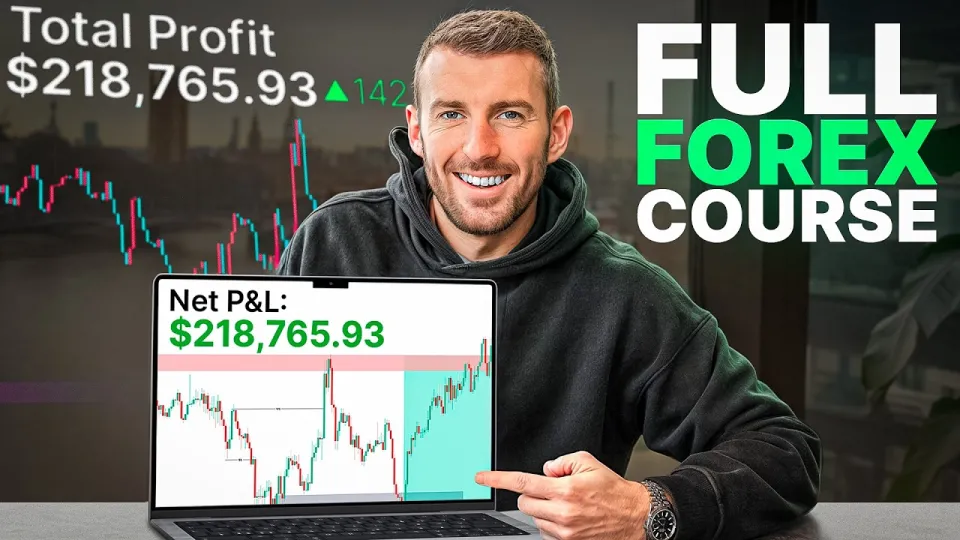
Video: Beginners Guide To Forex Trading In 2026 (+3 hours)
Want articles like this for your own video to promote it on YouTube and Google? Order them through the Telegram bot @sat_sit_bot. It writes articles around your video, embeds the video and publishes them on popular niche websites (no ads). Free trial — 50 articles.
· based on the channel Matt Donlevey - Photon Trading
Forex is the global market where national currencies are traded in pairs, and it is the largest and most liquid financial market in the world, open 24 hours a day on weekdays. Beginners who want a working approach should learn the mechanics first — bid, ask, spread, orderbook and orderflow — and only then build a strategy on market structure, supply and demand, liquidity and strict money management. The free Photon Trading beginner course from Matt Donlevey, available at the Photon Trading free training page, walks through exactly that sequence in a single sitting.
What forex trading actually is and who is on the other side
Forex trading means buying one currency while selling another, so every position is a pair such as EUR/USD, and the profit or loss comes from the change in the exchange rate between them. Participants range from central banks and commercial banks to hedge funds, corporations hedging export revenue and retail traders on leverage. Because there is no single exchange, the market is decentralised and split into sessions: Sydney, Tokyo, London and New York. Liquidity concentrates when sessions overlap, which is why London and New York hours usually produce the cleanest moves and the tightest spreads, while the quiet hours between sessions produce thin ranges and false breaks.
Retail traders reach this market through a broker, and the broker's job is to route orders into the underlying liquidity. That is why the choice of broker and the cost structure deserve real attention rather than a five-minute comparison of welcome bonuses.
How money is actually made in forex
Profit in forex comes from price movement, and price moves because of an imbalance between buyers and sellers — nothing else. A trader can earn in three broad ways: trading their own capital, trading a funded account provided by a proprietary firm, or managing other people's money once a track record exists. The first is the realistic starting point.
Returns are a function of three variables: the edge in the strategy, the amount of risk taken per trade, and the number of trades. A common beginner mistake is to chase large percentage gains with oversized positions, which turns a statistically sound strategy into an account-destroying one. Realistic expectations matter: a strategy with a modest edge and controlled risk compounds over hundreds of trades, while a strategy with no edge loses regardless of position size. Prop firm funding is a legitimate route to more capital, but it demands the same discipline — passing an evaluation is a risk-management test, not a trading-genius test.
Why technical analysis fails without market dynamics
Technical analysis has a poor reputation because most of it treats geometric shapes as causes, when patterns are only a visual side effect of orderflow. A trendline does not move price; resting orders and aggressive market orders do. The productive approach is to understand the underlying dynamics first and then read charts as a map of where liquidity sits.
Candlesticks are the basic unit of that map: the body shows the open-to-close range and the wicks show where price was rejected. Market microstructure explains the rest. The bid is the highest price a buyer will pay, the ask is the lowest price a seller will accept, and the spread between them is an immediate cost on every position. The orderbook shows resting limit orders at each price level, and auction market theory explains that markets move to find areas where buyers and sellers agree on value. Orderflow is the record of who is aggressive and in which direction.
The Photon Trading framework in five building blocks
Matt Donlevey's approach, presented on the Matt Donlevey - Photon Trading channel, assembles a systematic strategy from five components that must be read together rather than in isolation.
- Market structure. Identify swing highs and lows and determine whether the sequence is bullish, bearish or ranging. Structure gives the directional bias and the invalidation level.
- Three types of structure. Distinguish internal structure inside a leg from external structure that defines the larger swing, so a pullback is not mistaken for a reversal.
- Premium and discount. Within a dealing range, buy in the discount half below the midpoint and sell in the premium half above it. This prevents chasing price at the worst part of the range.
- Supply and demand. Mark zones where price left sharply with little overlap, because those areas represent unfilled orders rather than arbitrary rectangles.
- Liquidity. Locate stop clusters above equal highs and below equal lows, since price is frequently drawn to those pools before continuing.
Multi-timeframe analysis ties the blocks together: the higher timeframe sets the bias and the zone, the lower timeframe times the entry. A trade is only valid when the narrative is consistent across timeframes.
Execution, costs and the plumbing of a trade
Execution quality decides whether a good idea becomes a good result. Before placing an order, a trader should know the spread, whether commission is charged per lot, what the swap or rollover cost is for holding overnight, and how much slippage the broker typically shows during news. These trading costs compound over hundreds of trades and can erase an edge that looks profitable on a chart.
Entries are usually taken on a lower-timeframe confirmation inside a higher-timeframe zone, with the stop placed beyond the level that invalidates the idea. Trade management then covers partial exits, moving to breakeven and letting a runner continue. Money management caps risk per trade as a fixed percentage of the account and limits total exposure, which is what keeps a losing streak survivable.
Common beginner questions and mistakes
Beginners tend to make the same three errors: risking too much per trade, jumping between strategies before any of them has been tested, and trading without a written plan. A fourth, quieter error is skipping the boring parts — backtesting and journaling.
Backtesting means running the rules over historical data and recording the outcome of each setup, which produces the sample size needed to judge an edge. Journaling records the reason for entry, the emotion at the time and the result, which turns repeated mistakes into visible patterns. Trading psychology is often presented as the final boss, but it is far easier to control emotions when the strategy has already been proven and the risk per trade is small enough to be uninteresting.
A frequent concern is pace: a dense, fast-paced course can feel overwhelming, especially for non-native speakers. The practical fix is to pause on one topic at a time and apply it to a chart before moving on, rather than watching three hours in one sitting. Another common question is whether such material is genuinely free — the Photon Trading course and cheatsheets are distributed at no cost through the training link, with paid mentorship offered separately.
Useful links
- Free Photon Trading course and cheatsheets
- Photon Trading mentorship
- Photon Trading Telegram channel
- Photon Trading on Instagram
Final thoughts
Forex rewards traders who understand mechanics before patterns: orderflow explains price, structure explains direction, and risk management decides survival. The Photon Trading guide by Matt Donlevey is a rare case of a complete curriculum — from bid and ask through liquidity concepts to a written trade plan — released as one free, timestamped resource instead of scattered clips. Work through it slowly, backtest every rule, journal every trade, and treat the free Photon Trading beginner course as the starting point rather than the finish line. The channel Matt Donlevey - Photon Trading is the author of that breakdown and the place to follow for further analysis and trade recaps.
Key takeaways
- Forex is the largest financial market in the world, trading around the clock on weekdays across sessions in Sydney, Tokyo, London and New York.
- Price moves because of orderflow: bids and asks meeting in an orderbook, with the spread as the cost of every trade.
- Matt Donlevey of Photon Trading built a full systematic strategy on market structure, premium and discount zones, supply and demand and liquidity.
- A trade plan, backtesting, journaling and money management are treated as core parts of the strategy, not optional extras.
- The full beginner course is free via the Photon Trading training link, with mentorship and a Telegram channel as follow-ups.
Questions & answers
How much money do I need to start trading forex?
You can open an account with a small deposit, but the amount matters less than the risk per trade. Risking a fixed small percentage of the account on each position lets even a modest balance survive a losing streak, while an oversized position can wipe out a large account in a few trades.
Can I learn forex trading for free?
Yes. The Photon Trading beginner course and cheatsheets are distributed free through the training link, and the Telegram channel publishes analysis and trade recaps at no cost. Paid mentorship exists for traders who want structure and accountability, but it is not required to learn the fundamentals.
How long does it take to become consistently profitable?
There is no fixed timeline, and anyone promising one should be treated with suspicion. Progress depends on how quickly you build a tested strategy, collect a meaningful sample of backtested and live trades, and fix the mistakes your journal reveals — usually a matter of many months, not weeks.
Is technical analysis useless in forex?
Patterns alone explain little, because shapes are a side effect of orderflow rather than its cause. Technical analysis becomes useful when it is read as a map of liquidity, supply and demand, and market structure, with the higher timeframe setting the context for lower-timeframe entries.
Source: Beginners Guide To Forex Trading In 2026 (+3 hours) · Markdown version