How to Find a High-Quality Entry on Meme Coins Without Chasing the Pump
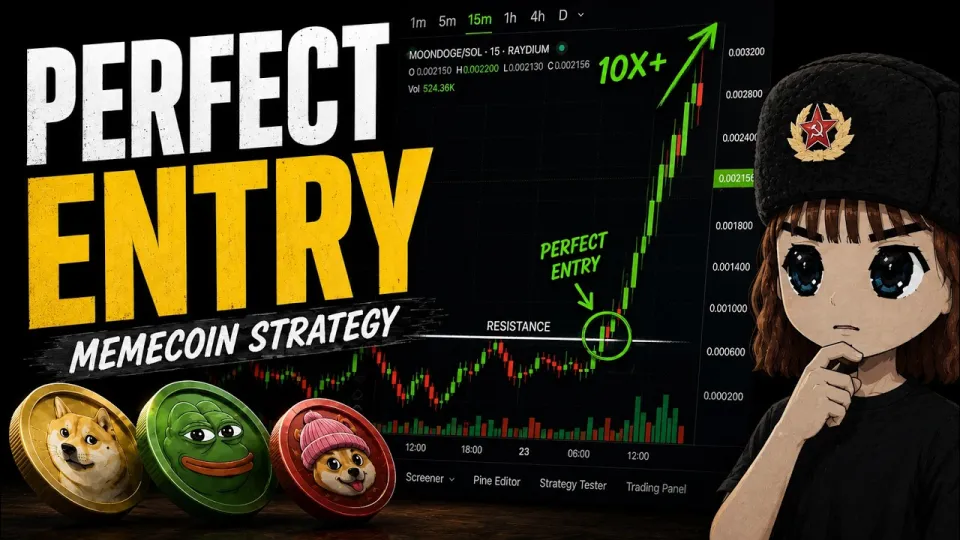
Video: How I Find the PERFECT Entry on Memecoins 📈 (Full Strategy)
Want articles like this for your own video to promote it on YouTube and Google? Order them through the Telegram bot @sat_sit_bot. It writes articles around your video, embeds the video and publishes them on popular niche websites (no ads). Free trial — 50 articles.
· based on the channel starwifpump
Most meme coin traders do not lose because they picked the wrong token — they lose because they bought at the wrong moment. A meme coin entry is only worth taking when momentum, a pullback to a real support level, and an intact chart structure line up at the same time; if one of those is missing, the correct move is to wait. The full breakdown of this process comes from starwifpump's strategy video, and a free tool stack to practise it is available through the Plasma Telegram early-access channel.
Why the meme coin entry matters more than the pick
Entry price sets the entire risk-to-reward profile of a trade, so the same token can be a good trade or a bad one depending on where you bought. A trader who enters after a 300% vertical move needs the price to keep running just to break even on a normal retrace, while a trader who buys the first clean retest of a broken resistance sits far closer to invalidation. That distance between entry and invalidation is what defines position size and, ultimately, whether a string of losses is survivable. Meme coins are especially unforgiving here because liquidity is thin and drawdowns of 40–60% inside a single session are routine, not exceptional.
The practical consequence is simple: spend more time on the chart and less time on the narrative. A strong story with a bad entry produces a losing trade, and a mediocre story with a disciplined entry can still be managed into a profit.
The three confirmations before any meme coin buy
A valid setup requires momentum, a pullback, and structure to agree, and each one answers a different question. Momentum tells you whether money is actually flowing in, the pullback tells you whether you are paying a fair price, and structure tells you where you are wrong.
- Momentum without chasing. Look for rising volume alongside higher highs on the lower timeframes. If the candle is already extended far from its moving average and volume is spiking into a vertical move, you are late, not early.
- A pullback to a defined level. The best entries come on a retest of a prior breakout level, a moving average that has been respected, or a consolidation floor. The level must exist before the pullback arrives — drawing it afterwards is rationalisation.
- Intact structure. Higher lows on the entry timeframe, no break of the most recent swing low, and no long upper wicks dominating the recent candles. If structure is already broken, there is nothing to confirm.
How to use pullbacks and support to improve the entry
A pullback is only useful if you know in advance where it should stop, so mark your levels before the move happens. On a token that has just broken out of a range, the top of that range becomes the first support to watch; on a token in a steady trend, the moving average that has repeatedly held becomes the reference. When price returns to that zone, you want to see the selling slow down — smaller candles, wicks buying back, volume drying up — rather than a fast candle slicing straight through.
A useful habit is to split the entry: take a partial position at the first touch of support and add only if the level holds and momentum resumes. This keeps you from being fully exposed to a level that has not yet proven itself, and it removes the pressure to catch the exact bottom, which nobody does consistently.
Signals that tell you not to enter
The most valuable skill in meme coin trading is knowing when to skip a trade, and the warning signs are usually visible before the entry. A vertical candle with no prior base, a chart that has already printed several 2x–3x legs in a short window, or a sudden volume spike that immediately fades are all signs that the easy money has been made.
Other red flags worth respecting:
- Price loses the level you planned to use as support, then reclaims it weakly on declining volume.
- The token keeps printing long upper wicks while making marginal new highs — distribution, not accumulation.
- The move depends entirely on a single announcement or influencer post with no follow-through buying.
- Liquidity is thin enough that a normal-sized order moves the price several percent.
When any of these appear, the correct action is to close the chart and look for another token. There is no penalty for missing a trade; there is a real penalty for taking a bad one.
Planning risk, exits, and profit-taking before the trade
Risk is decided before the position exists, not after the price starts moving against you. Define the invalidation level first — the price at which your reason for the trade is simply wrong — then size the position so that a stop at that level costs a fixed, small percentage of your account. If the distance between entry and invalidation is wide, the position gets smaller; that single rule prevents most account blow-ups.
On the exit side, plan profit-taking in tranches. Selling a portion into the first strong push locks in gains and removes the emotional temptation to hold everything for an unrealistic target. Trail the remainder behind structure — a moving average or the last higher low — so a trend can run without giving back the whole move. Writing these levels down before entry is what turns a one-off win into a repeatable process.
Common beginner questions about meme coin entries
Beginners usually ask the same handful of things, and the answers are mostly about patience rather than secret indicators. Whether you trade Solana tokens or another chain, the mechanics of momentum, support, and invalidation are the same; what changes is speed and liquidity, so size accordingly. Trackers and social feeds are useful for finding candidates, but they are filters for attention, not entry signals — the chart still has to confirm the setup.
A trader who lost money and is considering coming back should first rebuild the process on paper or with tiny size. Practising entries with a paper-trading mode, as offered by tools promoted alongside the strategy, lets you test whether your read of momentum and support actually works before real capital is at risk.
Useful links
- Plasma Telegram early access — tooling, updates, and setup help
- starwifpump Discord — community and live trade discussion
- Padre terminal VIP access
- Solpump
- starwifpump on X
Bottom line
A meme coin entry is a checklist, not a prediction: momentum, a pullback to a pre-marked level, and intact structure must all agree before capital goes in. Skipping bad setups and sizing from the invalidation level does more for long-term results than any single call. starwifpump lays out this framework in full, and the Plasma Telegram channel is where the accompanying tools and early access live. Treat every trade as one repetition of a process, not as a bet you have to win.
Key takeaways
- Most meme coin losses come from bad timing, not bad coin selection — entry price decides the risk-to-reward ratio.
- A quality setup needs three confirmations: momentum, a pullback to support, and a chart structure that has not been broken.
- Chasing a vertical green candle is the most common FOMO mistake; waiting for a retest usually improves the entry.
- Invalidation signals — lost support, fading volume, a blow-off top — are reasons to skip a trade, not to average down.
- Risk, exit levels, and profit-taking targets are planned before the position is opened, not after.
Questions & answers
What is the best time to enter a meme coin?
The best entry is usually the first clean pullback after a breakout, where price retests a level you marked in advance and selling pressure visibly slows. Entering during a vertical green candle means paying the worst price of the move, which destroys your risk-to-reward before the trade even starts.
How do I avoid FOMO when a meme coin is pumping?
Decide your levels before the move and accept that missing a trade costs nothing. If the candle is already extended far from its base and volume is spiking into a vertical run, the setup has passed — wait for a retest or move to another token.
Do I need special indicators to find meme coin entries?
No. Price structure, volume, and a few marked support levels cover most of the work. Trackers and social feeds help you find candidates, but they are attention filters, not confirmation — the chart still has to show momentum with an intact structure.
How much should I risk on a single meme coin trade?
Set the invalidation level first, then size the position so a stop there costs a small fixed percentage of your account. Because meme coins can drop 40–60% in a session, smaller size and planned profit-taking in tranches matter more than the size of any single win.
Source: How I Find the PERFECT Entry on Memecoins 📈 (Full Strategy) · Markdown version